

TheRealReal exhibition of superfake bags in New York City
In today’s luxury landscape, the signs of quality—hand-finished details, artisanal production, and traceable materials—have not vanished, but they have been rendered optional. The symbolic value of provenance, once tied to history and labor, is increasingly displaced by the performance of exclusivity. The rise of dupes and superfakes, the normalization of knockoffs, and the embrace of mass-market versions of luxury all point toward a culture of post-provenance luxury. In this world, what matters is not whether something is crafted in a Florentine atelier but whether it looks expensive and resonates with familiar codes of luxury. In this cultural shift toward post-provenance, quality has been displaced by spectacle and luxury has become an atmosphere. At stake is the symbolic infrastructure of luxury itself—its ability to anchor identity, signify value, and organize aesthetic hierarchies.
Traditionally, provenance underpinned the value of luxury goods, signifying an aura of legitimacy rooted in heritage, artisanal craft, and scarcity. Thorstein Veblen’s theory of “conspicuous waste” captured the sociocultural function of such goods: their value lay not in utility, but in signaling refinement and socio-economic power. Their purpose is performative, not practical. Even a perfect counterfeit loses value once revealed, he argues, not because it fails functionally, but because it fails symbolically. Provenance, in this view, is as much about craftsmanship as it is about class signification.
By the late twentieth century, the industrialization of fashion began to unravel provenance’s material roots. Craft was replaced with branding and exclusivity gave way to scalability. Paradoxically – or not – marketing around heritage intensified. Campaigns still invoked the romance of artisans and ateliers, even as production lines moved offshore. Provenance no longer required evidence, just good storytelling.
This marked a crucial pivot: provenance stopped being a record of origin and became a mere symbol unmoored from any tangible reality. It no longer mattered who made the garment, but whether it looked like it had been made by someone who mattered. A monogram became proof enough. An embossed logo was heritage distilled to its purest sign.
At the same time, a new generation of consumers—raised on Instagram, e-commerce, and reality TV—learned to parse the codes of luxury not through touch, but through image. The rise of high-quality knockoffs and mass-market “inspired” pieces made it clear that material difference between the genuine goods and their imitations was often negligible. What mattered was the surface: whether something felt luxurious, and whether it performed status convincingly enough.
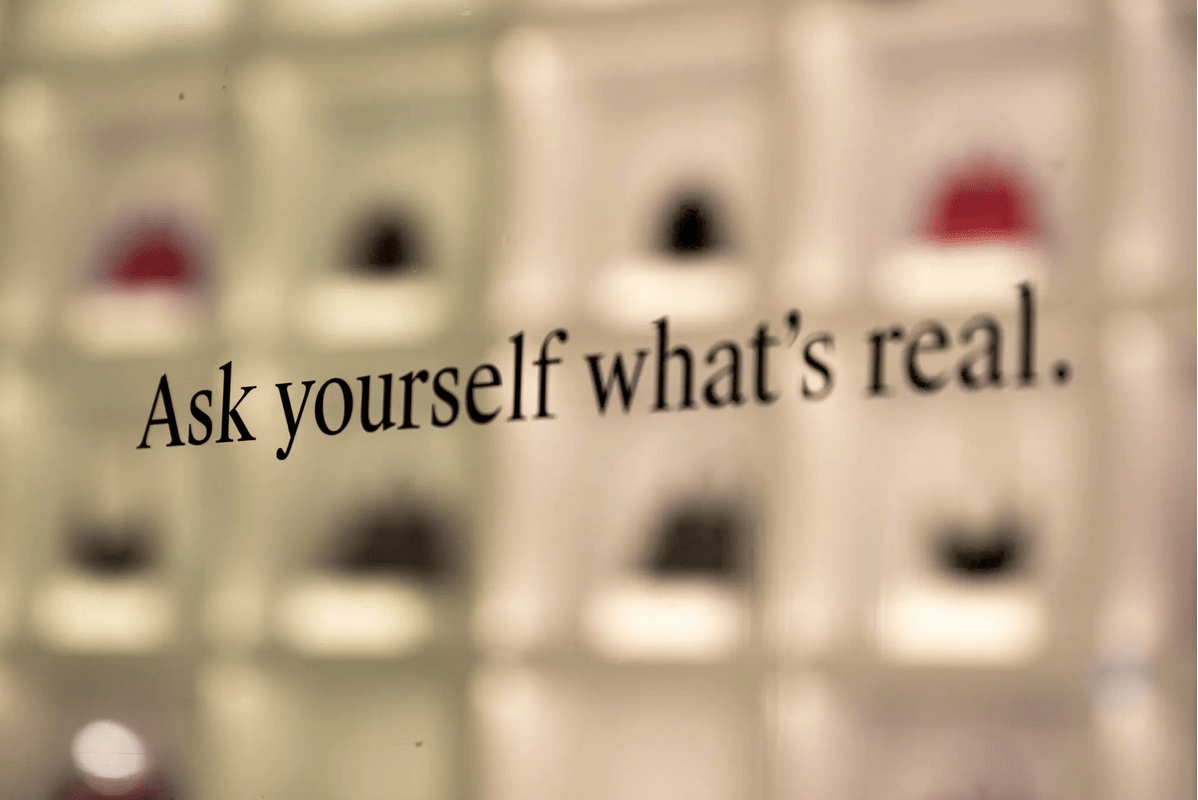
TheRealReal exhibition of superfake bags in New York City
This current fashion landscape—defined by images, impressions, and infinite scroll—finds its theoretical roots in the work of Guy Debord and Jean Baudrillard. For Debord, the spectacle is not merely a set of images, but a “social relationship between people that is mediated by images.” In modern societies, Debord argues, people no longer relate to each other—or to reality—directly. Instead, their experiences, values, desires, and understandings of themselves and others are shaped and filtered through images, especially commercial ones. In the context of luxury fashion, this means consumers rarely interact with the actual provenance of a product. Instead, they interact with the image of the product—a perfectly styled campaign, a curated Instagram feed, a glossy editorial spread. These images do more than just show luxury; they define how we understand it, aspire to it, and relate to others through it. The spectacle no longer needs the real to ground itself; it becomes the infrastructure of its own replication.
Baudrillard anticipates this transition in Simulacra and Simulation, where he theorizes a collapse in the relationship between sign and referent. He outlines a four-stage progression in which representation moves from reflecting reality, to disguising it, to denying its existence, and finally, to replacing it entirely with a simulation that bears no connection to any original. At this final stage, the sign becomes pure simulation: a copy without an original, a surface without depth. This is what Baudrillard terms the hyperreal—a reality constructed entirely through signs, one that is “more real than the real,” because it is built to satisfy aesthetic and ideological expectations more perfectly than lived experience itself. This phenomenon, which he calls the “precession of simulacra,” offers a crucial framework for understanding the degradation of provenance in contemporary luxury. A luxury handbag is no longer a product of craftsmanship. It’s a symbol referencing other symbols: the ad campaign, the influencer unboxing, the brand image. It is valuable because it resembles something that resembles value. As does a superfake, which the consumer buys because provenance no longer matters. A superfake can trigger the same response as the original—because the symbolic labor has already been done. In the image economy, origin is irrelevant. The dupe isn’t a threat from outside the system. It’s the system folding back on itself.
What emerges is a paradox: the better brands become at intertwining their logo with the aesthetic codes of exclusivity, the easier they become to reproduce. Brands that once depended on scarcity now depend on style fluency—and that’s a game anyone can learn. Luxury fashion has always dealt in illusion, but its persuasive power has historically rested, at least in part, on material evidence. ‘Provenance,’ despite its recent fictionalization, has played a central role in lending luxury its symbolic power. This lies not simply in its cost or exclusivity, but in the ability to make history feel tangible. Through the language of craftsmanship — hand-stitched leather, centuries-old techniques, atelier traditions — luxury goods promise more than aesthetic pleasure. They offer the fantasy of a coherent past, one in which social hierarchies are stable, time moves in a linear fashion, and cultural value can be both inherited and owned. When a consumer holds a luxury handbag, they’re not just displaying wealth, they’re grasping what appears to be a fragment of a longer, grander historical narrative. Provenance, in this framework, is not just about origin—it is about order. The artisanal bag, the hand-finished shoe—these are not just fashion items; they are evidence that the stories we tell about refinement, lineage, and taste have a basis in reality.
But in a post-provenance economy that narrative begins to unravel. As luxury is increasingly defined by its surface rather than its substance, it loses its ability to ground the very hierarchies it once performed. The crisis, then, is not about truth. It’s about meaning. What does luxury mean when its gestures can be perfectly reproduced? In a provocative reflection on the threat posed by simulation to religious belief, Baudrillard describes the fear of the Iconoclasts, early Christian reformers who rejected religious icons: “But what if God himself can be simulated, that is to say can be reduced to the signs that constitute faith? Then the whole system becomes weightless, it is no longer itself anything but a gigantic simulacrum—not unreal, but a simulacrum, that is to say never exchanged for the real, but exchanged for itself, in an uninterrupted circuit without reference or circumference.” Replace ‘God’ with provenance and ‘faith’ with luxury, and the danger becomes clear: “What if provenance itself could be simulated, that is to say, reduced to the signs that constitute luxury?” Then the whole system becomes weightless. The image no longer documents; it performs. It does not represent luxury—it is luxury. The Iconoclasts smashed images of God not because they were disbelievers, but because they feared that images might render belief meaningless. If luxury brands want to survive, perhaps they should do the same—disavow the image. Burn the influencer contracts. Retreat to the atelier. Not to save craft, but to save belief. Because the shimmer of the simulation doesn’t just replace reality, it threatens to lay bare a far more damning truth: that the image was the object all along.
Text by Mackenzie Mendez


